


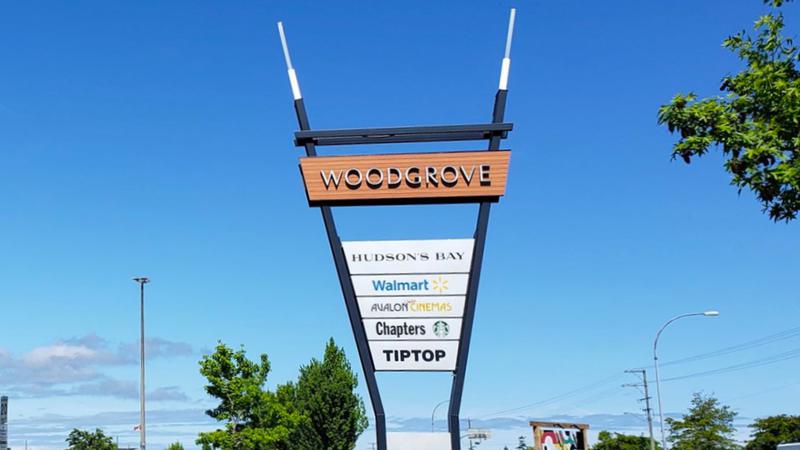
NANAIMO — More progress is being made on the plan to transform a busy north Nanaimo area into a complete community, with more family-friendly areas, green spaces, and increased transportation options.
The results from the phase one engagement study for the Woodgrove Area Plan (WAP), along with an update on the in-progress second phase, were presented during the Monday, June 16 regular council meeting.
Phase two involves looking at three growth scenarios for the area based on community feedback collected in phase one, related to housing, transportation, infrastructure, retail, and access to daily needs.
A total of 1,297 people between the ages of 20-65+ participated in the engagement process, as well as around 90 children from two school groups, with 90 per cent saying they were Nanaimo residents and 80 per cent homeowners.
Ease of access to shopping and retail outlets was highly rated by respondents, with people saying they normally go to the area for a specific service rather than for the “overall experience.”
Traffic and transportation issues, pedestrian safety, few cultural and recreational amenities, a lack of urban design and community feel were some of the things people did not like about the area, saying it had a “concrete jungle” vibe.
More active transportation lanes for pedestrians and cyclists were also mentioned, as well as more access to transit.
In terms of housing, increased and affordable housing density through careful planning saw support, while concerns were voiced about the traffic impacts an increased population would cause.
More green spaces were also desired, along with an emphasis on making residents feel safe in their community.
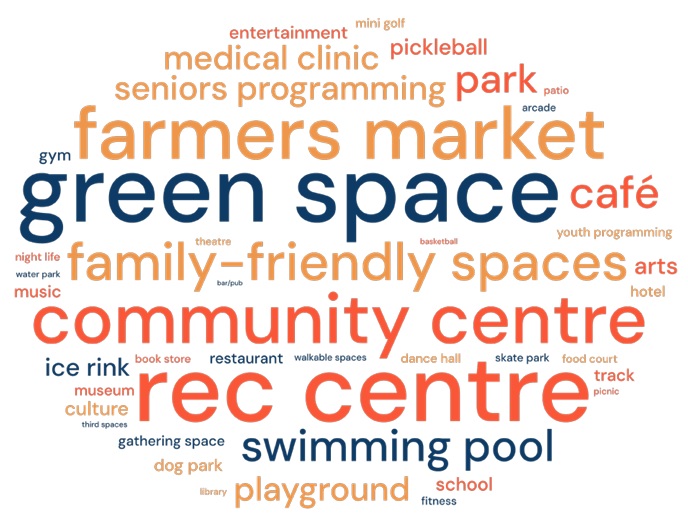 A word cloud indicating what amenities people would like to see in the Woodgrove area, with the size of the text indicating its popularity. (City of Nanaimo)
Three scenarios, with population growths of 2,500, 5,000, and 7,500 people, along with corresponding increases in housing units and retail space, were created to better understand the implications of future growth in the area, informed by the City’s Nanaimo Reimagined plan.
For scenario one, even with new pedestrian and cycling links, a park and open space at the proposed Bower District site improving the active transportation network, major gaps in walking and cycling networks would persist, with an estimated cost of $50 million.
With transit centralized in the west at Woodgrove Centre, the area would still be reliant on vehicles.
Scenario two would involve moving the transit exchange and adding more cycling routes to improve access, but increased traffic would still put pressure on key routes, with an estimated cost of $100 million.
Scenario three would involve the largest enhancements to active transportation infrastructure.
Combined with more frequent transit service, it would provide the highest level of improvement with an estimated cost of $150 million.
In all three scenarios, phased upgrades to infrastructure like sewer systems, water, stormwater, hydro and natural gas would all require major upgrades, ranging from $2.75 million for scenario one, to over $6 million for scenario three.
Next steps include informing the community of the results from phase two, with feedback obtained used to create phase three, the ‘Preferred Scenario.’
Supporting policies and guidelines will then be established for an official document to find the best way to implement those findings to meet the future needs of the Woodgrove Urban Centre.
More information on the WAP, including how to participate in the phase two survey, can be found here on the City’s website.
Subscribe to our daily news wrap. Local news delivered to your email inbox every evening. Stay up to date on everything Nanaimo and Oceanside.
info@nanaimonewsnow.com
Follow us on: Twitter (X) | Bluesky | Facebook